AP or IB in Hanoi: Choosing the Curriculum That Survives Your Next Posting
Posted On: 22 September, 2026
Relocating again in a year or two? Here's how expat families in Hanoi should weigh AP against IB — credit recognition, university outcomes, and what actually travels with your child.
AP or IB in Hanoi: Choosing the Curriculum That Survives Your Next Posting
Can a Child Switch Mid–High School? What Actually Happens at Grade 9, 10, or 11
Timing decides difficulty far more than the programmes' relative rigour does.
Grade 9 or early Grade 10: Switching between tracks is low friction. Neither AP nor IB has locked the student into a fixed two-year sequence yet, so a family arriving in Hanoi at this stage can choose — or a school offering both tracks can place the student — without academic penalty.
After Grade 10: The constraint tightens considerably. IB's Diploma Programme is a fixed two-year commitment starting in Grade 11; joining after that window has opened forces a student into partial-credit arrangements or a compressed catch-up plan that schools handle in different ways. A student arriving mid-way through an AP sequence has an easier time of it, since AP courses stand alone by subject rather than running as a single connected programme.
Late arrival into Grade 10, specifically: This is the tightest window worth flagging. A student joining a new school partway through Grade 10 still has time to prepare for an IB Diploma start in Grade 11, provided the receiving school reviews the transcript early enough to spot subject gaps — chemistry or a second-language sequence, most commonly — before the Diploma's two-year clock starts running.
Arrival point
IB Diploma feasibility
AP feasibility
Grade 9
Full flexibility
Full flexibility
Early Grade 10
Full flexibilitywith early subject-gap review recommended
Full flexibility
Late Grade 10 / start of Grade 11
Feasible onlywith proactive transcript review and subject alignment
Feasiblelower friction
Mid-Grade 11 or later
Generally not feasiblefor the full Diploma; partial coursework only
Feasiblefor remaining exam subjects
MISTAKES TO AVOID:
Choosing the programme based on the posting letter's country, not its date: Families often start researching recognition rules for the destination country the moment the posting is announced — but by then the child may already be three months into Grade 11's IB sequence. The decision window closes long before the move itself; it closes when the academic year starts, whenever the transfer actually gets confirmed.
Assuming a "provisional" IB entry after the two-year window has started is the same as a full Diploma: Some schools will let a late-arriving student join IB coursework after Grade 11 has begun, but this often means a Course Certificate rather than the full Diploma — a meaningfully different credential for university applications. Confirm which one is actually on offer before assuming continuity is preserved.
Treating AP's flexibility as risk-free just because it's subject-by-subject: AP's independence makes switching easier, but it cuts both ways. A student who's taken AP Calculus AB in Hanoi might, say, find a US high school back home expects AB and BC before senior year — course sequencing isn't always identical from one country to the next.
Which International Schools in Hanoi Actually Offer This Flexibility
Hanoi's expat-facing school landscape clusters around Tây Hồ, Ciputra, and the neighbourhoods historically associated with the UN and diplomatic community, where several schools hold IB World School authorisation, AP College Board authorisation, or, increasingly, both. A family prioritising portability should treat "offers both tracks" as a distinct filter from "offers AP" or "offers IB" alone — dual-track access is what actually preserves optionality if the next posting is still unconfirmed.
During a campus visit, three questions tend to reveal whether a school genuinely supports a rotating family rather than simply listing a curriculum on its website:
Does the school run its own designated SAT/AP testing centre on-site, or does it depend on an external venue?
What proportion of the current cohort transferred in mid-programme from another AP or IB school, and how did the school handle their credit evaluation?
Is there a formal, named process — not an informal promise — for issuing a digitised, internationally readable transcript within a set number of business days of a withdrawal request?
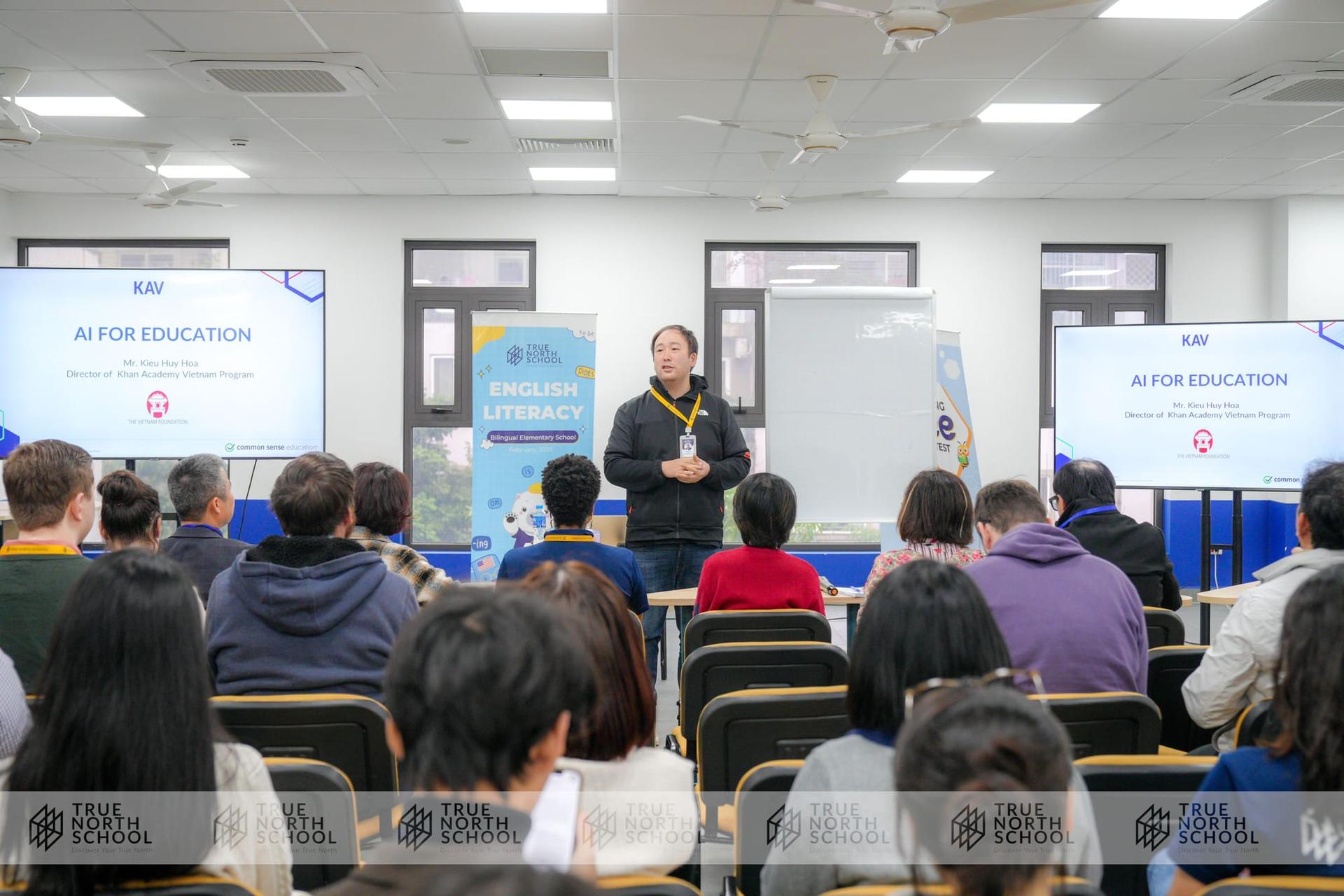
True North International School answers the first of these directly: it operates as an official SAT/AP testing centre and offers more than 15 AP subjects. In AY23-24, its students posted an average AP score of 4.4 out of 5, with a 98 percent pass rate at 3-or-above — figures specific to that cohort and testing year, offered here as a data point rather than a promise to every incoming student.
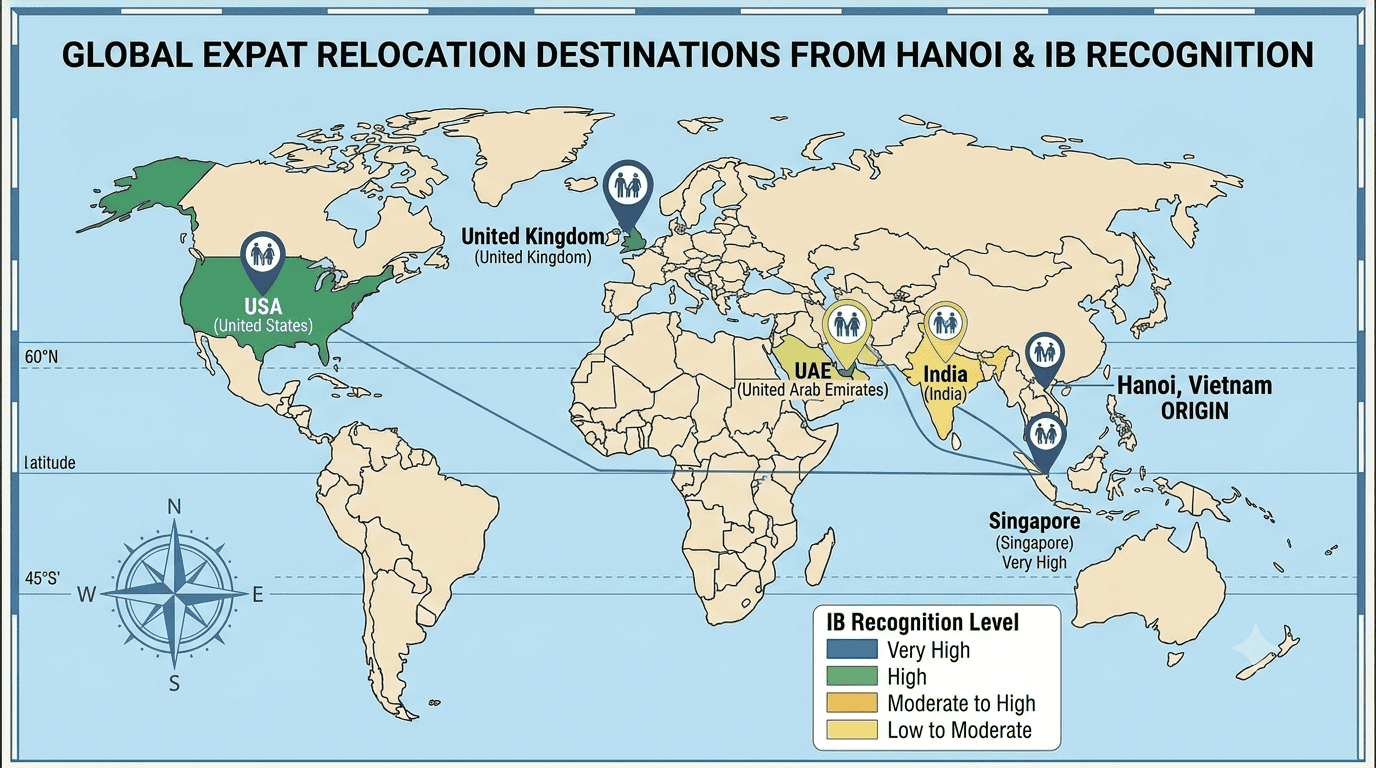
"In the UAE's 2026 IB cohort, students averaged a Diploma score of 34.5, against a global average of 30.88 — a strong result for one market, though not evidence of a global pattern across every IB school."
Tuition, Company Education Allowances, and the Real Cost of Getting This Wrong
International school tuition in Hanoi for expat-track programmes typically runs to roughly €12,000–€32,000 a year (approximately 320–850 million VND) — a spread wide enough that a corporate education allowance calibrated for one programme may fall short if a mid-year transfer pushes the family into a different school's fee bracket. For a full breakdown of what an AP-track education actually costs at one Hanoi campus — tuition, entrance assessment, and enrolment fees — see True North School Tuition Fees.
"International school tuition for expat families in Hanoi typically runs €12,000–€32,000 per year (approx. 320–850 million VND) — a wide enough spread that a fixed education allowance may not cover a mid-posting switch between AP and IB tracks."
— Maison Hanoi (indicative range, not a guaranteed figure for every school)
The cost families consistently underbudget isn't tuition — it's the remediation layer that follows a mismatched transfer: subject-gap tutoring to close a curriculum misalignment, an independent counsellor to re-map a college application list built around the wrong programme's strengths, and, in the worst case, a repeated academic year. None of this shows up on a standard fee schedule, which is exactly why it catches families off guard mid-posting.
PRO TIP FROM TRUE NORTH INTERNATIONAL SCHOOL: Ask your company's HR or mobility team one specific question: is the education allowance locked in at the start of the posting, or reviewed every year? This single clause determines whether a mid-posting transfer between AP and IB tracks is actually affordable. Many multinational and diplomatic packages lock the allowance to the first school's fee bracket for the full assignment length. If your child later needs remediation tutoring, or a different school's higher IB-track tuition after an unplanned switch, that gap often comes out of pocket rather than the allowance. Get this clause clarified in writing before enrolment, not after a transfer is already underway.
The Counter-Case: Why Some Families Should Ignore the Portability Argument Entirely
IB's global reach doesn't convince everyone, though. On general education forums, some former students argue directly that the IB Diploma gave them no measurable admissions advantage over a strong AP course load — one contributor recalled that a peer's college outcomes tracked no differently from students who'd taken AP and honours classes instead. That's one person's experience, not a documented trend, but it points to a real trade-off worth stating plainly: a child who thrives on deep, subject-specific study may simply do better inside AP's à la carte structure than inside IB's mandatory six-subject breadth, whatever the family's relocation calendar suggests is "safer".
"On one education forum, a former IB student argued the programme wasn't necessarily harder than AP — just differently focused — and noted it may suit schools that lack a strong AP offering more than it offers any inherent admissions edge."
— Forum contributor opinion, via Blind (one individual's experience, not a documented trend)
So this isn't really an "IB is better" argument. It's a genuine trade-off: portability and personal academic fit can pull in opposite directions, and a family fixed on a US university outcome, with a child who has clear subject strengths rather than broad interests, may reasonably choose AP even while accepting the transfer risk that comes with it.
How to Decide: A Short Framework Before Your Next Move
Three questions settle most of this before a family ever compares course catalogues:
Is the next posting country already known? If it is, check that country's specific recognition pattern for AP or IB rather than leaning on general reputation. If it isn't, weight IB's standardised international reach more heavily.
Is a US university the fixed, non-negotiable destination regardless of the stops in between? If so, AP's direct US credit pathway stays a defensible choice even without full portability.
What grade is the child in right now? Before Grade 11 begins, both programmes stay open. Once the IB Diploma's two-year sequence has started, switching gets a lot harder — and that's the deadline that actually matters, not the family's own relocation timeline.
Which Programme Fits Your Family's Posting Timeline?
Answer three quick questions to get a directional recommendation. This isn't a substitute for a transcript review — it's a starting point.
1. Do you already know your family's next posting country?
2. Is a U.S. university the fixed, non-negotiable goal regardless of future moves?
A transcript review before enrolment answers all three questions against the child's actual academic record, rather than assumptions about what "should" work. Families who ask for this early — months before a posting is confirmed, not after — tend to avoid the compressed, high-stress transfers that end up costing both time and money later.
Not sure which track fits your family's rotation schedule? Book a 1:1 consultation with True North's admissions counselling team to review your child's current transcript and get a personalised AP-or-IB transition roadmap before your next posting is locked in.
Frequently Asked Questions
How do I know if my child's AP score will be accepted at their next international school after we relocate?
AP scores don't transfer automatically — each receiving school evaluates them individually rather than converting them into a standardised equivalent. Before relocating:
Request a syllabus-level transcript (not just the score sheet) from the current school.
Contact the receiving school's admissions office directly to confirm which AP scores they accept for placement or credit.
Do this at least one semester before the move, since evaluation can take several weeks.
Recognition depends on the receiving school's own policy, not on any universal AP standard.
Can my child start the IB Diploma Programme after Grade 11 has already begun at their new school?
Generally, no — not the full Diploma. The IB Diploma runs as a fixed two-year sequence starting in Grade 11, and joining mid-year typically limits a student to a Course Certificate covering individual subjects rather than the full Diploma. Some schools allow catch-up arrangements for students arriving in the first few weeks, but this varies by institution. Families expecting a Grade 11 IB start should confirm placement eligibility with the receiving school before finalising the move.
What happens if my child has completed one year of IB and we move to a school that only offers AP?
The receiving school typically evaluates completed IB coursework on a subject-by-subject basis rather than converting it into equivalent AP credit. In practice: some subject knowledge transfers informally (IB Higher Level Maths preparing a student well for AP Calculus, for instance); formal AP credit generally requires sitting the actual AP exam; and a transcript and syllabus review with the new school's counsellor is the only way to confirm exact placement.
Is IB or AP better recognised by universities in India?
Both are recognised by most Indian universities and several state boards, but the process differs: IB Diploma holders typically go through some form of formal equivalency process, while AP credit recognition is usually assessed individually by each university's admissions office. Neither guarantees automatic equivalency — confirm the specific requirement directly with the target Indian university or board well before your child's final exam year.
My child is in Grade 9 — should we pick AP or IB if we don't know our next posting yet?
At Grade 9, either choice keeps options open. If the next posting country is genuinely unknown, IB's standardised global issuance tends to run into fewer transfer complications than AP's more US-centric structure. If a US university is already the fixed family goal, AP remains a reasonable choice. Where available, enrolling at a school offering both tracks preserves the most flexibility.
How can I check in advance whether a specific country will accept my child's IB Diploma?
IB Diploma recognition varies by country and even by university, despite the qualification being issued to a global standard. To verify in advance: search the destination country's ministry of education or national admissions body for its published IB equivalency table; contact the specific receiving university's international admissions office directly; and ask your current school's counsellor if they've handled a transfer to that country before.
What's the biggest mistake expat families make when switching between AP and IB mid-way through high school?
Waiting until the relocation is confirmed to request transcripts and syllabus documentation — which compresses a weeks-long process into a matter of days. This often forces rushed placement decisions, missed subject-gap identification, and unnecessary remediation tutoring. The fix: request a full syllabus-mapped transcript from the current school as soon as a posting becomes likely, not once it's confirmed.