What a Transcript Review Appointment Actually Covers Before You Enrol
Posted On: 27 October, 2026
Learn what a transcript review appointment actually covers before you enrol your child at an international school in Hanoi. This guide covers which documents to bring, how age and past grades shape placement, and how Vietnamese, Korean, Indian and Chinese report cards are read. It also explains which maths and language gaps affect AP or IB plans, and the rules for Vietnamese-passport students. Get a written provisional placement before you pay a deposit.
A transcript review appointment is a one-to-one meeting with the admissions team, held before you pay a deposit. The team reads your child’s report cards alongside their age, English level and learning history. It then recommends a grade, flags any subject gaps and decides which placement assessments are still needed.
The review matters most when records come from another system, language or school calendar. A Vietnamese học bạ, a Korean report card or a CBSE marksheet may mean something quite different to a new school than it does to you.
At True North International School (TNIS), an American-curriculum school in Hà Đông, Hanoi, the review looks closely at what your child has actually been taught, especially in maths and languages.
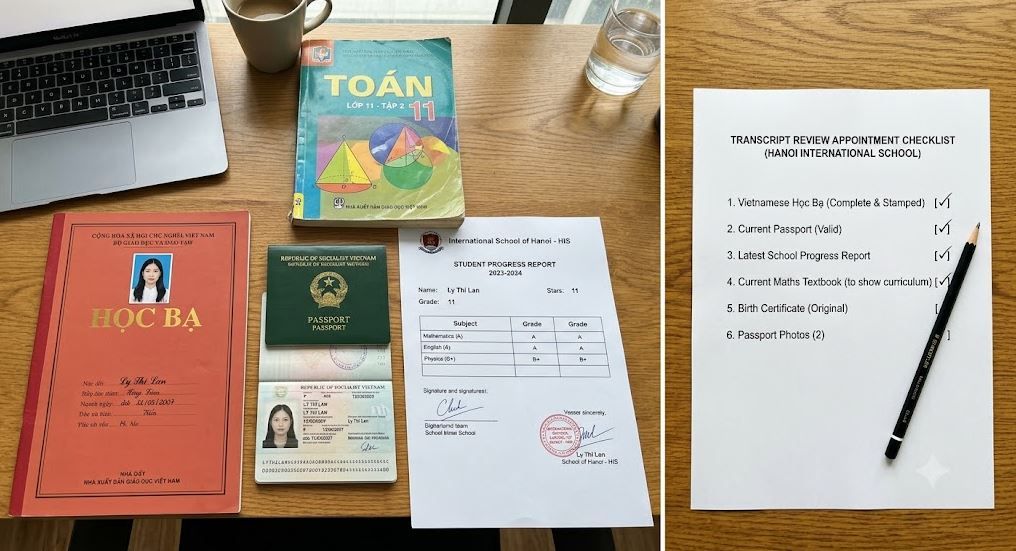
To get started, bring:
the last two years of report cards
the latest progress report, if your child left mid-semester
a passport or birth certificate
any test scores
any learning support plan
This guide also includes a printable document checklist, a sample Gap Map and five questions to ask before you pay a deposit.
What Is a Transcript Review, and How Is It Different From a Placement Test?
A transcript review looks back at your child’s past learning. A placement test measures where their skills are today. Most families need both: the review informs grade placement, and the assessment checks whether the transcript tells the full story.
Academic Evaluation & Placement
Compare assessment methods, processes, and outcomes
Criteria
Transcript review
Placement assessment
Application form
Independent credential evaluation
Purpose
Read past learning, spot gaps
Measure current skills
Register interest
Convert records formally
Run by
Admissions and academic leaders
Subject teachers or a test platform
Family
External agency
You receive
Provisional placement and gap plan
Score or level
Confirmation
Equivalency report
Binding?
Provisional
Feeds the final decision
No
Advisory
Transcript review
PurposeRead past learning, spot gaps
Run byAdmissions and academic leaders
You receiveProvisional placement and gap plan
Binding?Provisional
Placement assessment
PurposeMeasure current skills
Run bySubject teachers or a test platform
You receiveScore or level
Binding?Feeds the final decision
Application form
PurposeRegister interest
Run byFamily
You receiveConfirmation
Binding?No
Independent credential evaluation
PurposeConvert records formally
Run byExternal agency
You receiveEquivalency report
Binding?Advisory
At TNIS, we treat the review as a placement conversation. If you walk out with nothing more than a receipt for your documents, it hasn’t done its job.
What Documents Should You Bring to a Transcript Review?
Bring documents that show what your child was taught, as well as how they scored. Report cards give you results. Syllabi and textbook lists show the content behind them.
The core checklist
Document
Why it matters
Must-have?
No matching documents found.
PRO TIP FROM TRUE NORTH INTERNATIONAL SCHOOL: If you can't get an official syllabus, photograph the table of contents of your child's current maths and science textbooks. Mark the last chapter fully completed and the chapter in progress. Add the textbook title, edition and publisher. For an admissions team, these photos say more about learning sequence than a full year of grades, and they take five minutes to make.
Do report cards need certified English translation?
For the review itself, a clear working translation is often enough to get started.
Allow time for certified translation and certified copies (chứng thực), but don’t wait for them before booking the first conversation.
PRO TIP FROM TRUE NORTH INTERNATIONAL SCHOOL: Ask your translator to include the grading legend, not just the grades. Many translations render "8.5" or "Khá" faithfully but never explain what the scale means: the pass mark, the top band, or what each conduct or overall rating stands for. Without that legend, the reviewer has to guess. Also ask for subject names to be translated the same way on every page and every year. "Đại số" becoming "Algebra" one year and "Mathematics" the next makes a continuous course look like two different subjects.
What if your child left mid-semester?
The review still works from a progress report. It just relies more heavily on the placement assessment.
The Foreign Service Journal (Nov–Dec 2025) notes that students who leave before the end of a semester may get only a progress report or an unofficial transcript. That leaves the receiving school to work out credit questions on its own.
Ask for every interim report before your child’s last day at the old school.
What about unaccredited, online or homeschool records?
These records still count as evidence, but they carry less weight on their own.
Accreditation (CIS, WASC) affects how readily other schools accept a transcript. Without it, the placement assessment and a conversation with teachers play a bigger part in the outcome.
What Happens Inside the Appointment, Step by Step?
Every review at TNIS runs through the same seven checks. The written result is what we call the True North Gap Map: one page showing the provisional grade, the gaps, and who will close them.
Age and calendar check. Date of birth sets the default grade.
Grading scale. The old system’s scale is read in its own context.
Learning sequence audit. The last maths topic completed, and how many years of a second language.
English level. A low grade may reflect a language barrier rather than a knowledge gap.
Support needs. Any IEP, support plan or teacher notes.
Legal requirements. For Vietnamese-passport students: track choice and Vietnamese studies.
Provisional placement and Gap Map. Given to you in writing, with a clear next step.
Sample Gap Map (illustrative):
Area
Finding
Risk
Bridge plan
Owner
Review date
No matching records found.
True North International School
Inside a transcript review: 7 checks, 1 written plan
Every review ends with a one-page Gap Map you can take home.
1
Age & calendar checkDate of birth sets the default grade.
2
Grading scaleThe old system's scale, read in its own context.
3
Learning sequence auditLast maths topic completed; years of second language.
Can a child be moved down a year after the review?
It can happen, but it’s usually the last option on the table. In many cases, a targeted support plan can close a single-subject gap without your child repeating a year.
How well that works depends on the size of the gap, your child’s age and how much support time the school can offer.
Situation
Common response
No matching records found.
What about Southern Hemisphere and mid-year calendars?
Australian and New Zealand school years begin early in the calendar year. Indian CBSE years begin in April. On paper, your child might look half a year “ahead” or “behind”.
The Foreign Service Journal flags Southern Hemisphere and mid-year transfers as cases where the right grade level is often unclear. The review settles this by looking at the content your child has covered rather than the label on the report card.
Calendar mismatch estimator
Choose your child's current school system and the month you'll arrive in Hanoi. See how far through each school year your child will be, and what a transcript review should check.
Calendars are approximate and vary by school, state and year. This tool compares calendar progress only. It does not decide which grade your child joins; that depends on date of birth, records and a placement assessment.
How Are Report Cards From Other Systems Read?
A conversion chart can’t stand in for reading the content. Course equivalency depends on what the syllabus covered, whatever the course was called.
Situation
Common response
One-subject gap (e.g. maths)
Stay at age grade + targeted support
English is the barrier, content is fine
Age grade + EAL
Several core gaps + age near cut-off
Open discussion of grade options
Strong record + above-level assessment
Subject-level acceleration first
No matching records found.
How is the Vietnamese 10-point scale converted?
There’s no widely shared official formula for converting the 10-point scale to US grades, and schools interpret it differently. An 8.0 at one school may not mean the same as an 8.0 at another.
Why does a converted grade mean little on its own?
A grade tells you how well your child performed. The syllabus tells you what they performed on. The review needs both.
Which Subject Gaps Matter Most for Future Pathways?
Maths and second languages often matter most, because each new topic builds on the last. A missed unit can make everything that follows harder.
According to The Foreign Service Journal, there is no universal system for evaluating international transcripts. Gaps in the learning sequence, especially in maths and foreign languages, are among the common challenges that affect a student's placement.
Gaps aren’t the whole story, though. English level, settling in after a move and differences in teaching style can all affect how a child copes in a new class.
How does this affect AP and high school credits at TNIS?
The TNIS International Track follows US standards, with CCSS for maths and English and NGSS for science. It also offers College Board AP courses.
According to the school’s published fee schedule (checked October 2026), AP courses are included in International Track tuition. Bilingual Track students pay 18 million VND per AP subject.
For Grades 9–12, the review also maps your child’s previous courses to US high school credits.
What if your family plans for IB Diploma or A-Level elsewhere?
Check subject prerequisites now. At many schools, MYP results determine which IB Diploma subjects a student can take.
One example: International School Eindhoven's general guideline for IB Diploma entry asks for MYP level 5 or higher in intended Higher Level subjects and at least 28 points overall on the final MYP report. Other schools set their own thresholds.
If you’re not sure where your next posting will be, our guide to AP in Hanoi compares which curriculum travels better between countries.
Will a transfer hurt university applications?
A clearly documented transfer is generally easier to explain than an unexplained gap in the record. Keep every report card, and keep a note of why each move happened.
For context, TNIS’s first graduating Grade 12 class received offers from more than 30 universities, including Cornell, UCL, the University of Melbourne and the University of Sydney. Between them, they earned USD 3,000,000 in US scholarships and AUD 80,000 in Australia.
Results like these come from many factors, including students’ own work, family support and university counselling. One school’s results can’t predict any individual student’s outcome.
Do Vietnamese-Passport Students Face Different Rules?
Yes. Vietnamese citizenship triggers legal requirements that don’t apply to foreign-passport students. It’s a layer most expat-focused guides skip.
Under Circular 04/2020/TT-BGDĐT, Vietnamese-citizen students at foreign-invested international schools must study Vietnamese studies for at least 90 minutes per week in every middle and high school grade.
Vietnamese citizens at foreign-invested international schools
Vietnamese studies: at least 90 minutes a week in every middle and high school grade
Circular 13/2021/TT-BGDĐT
Anyone using a foreign school diploma in Vietnam
The provincial Department of Education and Training recognises foreign lower and upper secondary diplomas
Draft decree replacing Decree 86 (as revised by Decree 124/2024/ND-CP)
Vietnamese students in foreign upper-secondary programmes
Would lift the quota if all compulsory national subjects are covered (still a draft, not yet in force)
No matching records found.
MOET's draft decree to replace Decree 86/2018 (as revised by Decree 124/2024) would lift the cap on Vietnamese students in foreign upper-secondary programmes, provided those programmes cover all compulsory national-curriculum subjects. As of October 2026, it remains a draft.
Will a foreign high school diploma be recognised by Vietnamese universities?
It can be, once the diploma has been formally recognised. If a Vietnamese university is a possibility, plan for this early.
Under Circular 13/2021/TT-BGDĐT, the director of the provincial Department of Education and Training recognises foreign-issued lower and upper secondary diplomas. When the foreign issuing body must verify the diploma, the result can take up to 45 working days.
What if we return to a Vietnamese public school later?
Primary students returning from abroad follow a separate procedure. Under Circular 28/2020, parents submit a transfer request and the child’s transcript to the receiving school. Keep every report card, even after your child moves to an international school.
How does this shape the International vs Bilingual Track choice?
At TNIS, the Bilingual Track integrates the Vietnamese national programme, while the International Track follows the US curriculum. The review is where families weigh up plans for university in Vietnam against plans abroad.
Handing over the only original học bạ: Keep the original safe. Make several certified copies (bản sao chứng thực) before any school transfer. A return to the public system or a later diploma recognition may ask for documents you can no longer retrieve easily.
Leaving gaps in the record: Keep every year's report card, including years abroad and years at the international school. A missing year is far harder to explain at university application time than a weak one.
Choosing a track without a university plan: Decide early whether a Vietnamese university is still a real option. That one answer changes which track, which records and which certifications you need to keep from now on.
True North International School
Vietnamese passport vs foreign passport: what changes?
Three rules to check during a transcript review (as of October 2026)
.
Vietnamese passport
Foreign passport
Vietnamese studies
Vietnamese passportRequired
At least 90 minutes a week in every middle and high school grade at foreign-invested international schools.
Circular 04/2020/TT-BGDĐT
Foreign passportNot required by Circular 04
The Vietnamese studies requirement applies to Vietnamese citizens. Ask whether the school offers Vietnamese language or culture as an option.
Diploma recognition
Vietnamese passportPlan ahead
A foreign high school diploma must be recognised by the provincial Department of Education and Training before use in Vietnam, e.g. for a Vietnamese university.
Circular 13/2021 · up to 45 working days if verification is needed
Foreign passportOnly if used in Vietnam
The same Circular 13/2021 process applies if the diploma is used in Vietnam. Universities abroad follow their own country's rules.
Track choice at TNIS
Vietnamese passportKey decision
Weigh the Bilingual Track (integrates the Vietnamese national programme) against the International Track (US curriculum), based on university plans in Vietnam or abroad.
A draft decree may change quotas for upper-secondary students – not yet in force
Foreign passportUsually International Track
The US-curriculum International Track, with AP courses, is the usual fit. Ask admissions about Bilingual Track eligibility if relevant.
Summary for guidance only, as of October 2026. Requirements can change; confirm details with the school and the Hanoi Department of Education and Training.
How Are EAL and Learning Support Needs Handled?
A child’s EAL level changes how their grades should be read. A student who is still building their English may score poorly in science while understanding the science perfectly well.
Rule
Applies to
What it means (as of October 2026)
Circular 04/2020
Vietnamese students at foreign-invested international schools, lower and upper secondary
At least 90 minutes a week of Vietnamese studies
Draft decree replacing Decree 86
Vietnamese students in foreign high school programmes
Would remove the enrolment cap if compulsory subjects are covered. Still a draft
Circular 13/2021
Foreign lower and upper secondary diplomas
Recognised by the provincial Department of Education; up to 45 working days if verification is needed
No matching rules found.
The same pattern of low grades in text-heavy subjects can also point to a reading difficulty, a gap in earlier teaching, or simply a child still adjusting to a new school. That’s why the review should confirm the cause with an assessment instead of assuming it.
Share any support plan early. If it only comes to light after enrolment, support may take longer to start.
Parents who have shared feedback under their own names on the TNIS website describe what a smooth start can look like. The mother of a new Grade 8 International Track student wrote that daily encouragement from teachers, and help from older students, built her daughter’s confidence across subjects. A Korean parent noted how easily Vietnamese and Korean students play together.
Is it language or content? A 1-minute check
Six quick questions to help you decide what evidence to bring to a transcript review. This is a guide, not a placement decision.
Likely an English barrier → ask about EAL
Language
Content
Your answers suggest your child understands more than their grades show. The gap looks like English, not subject knowledge. In a transcript review, this usually means placement at the age-appropriate grade with EAL (English as an Additional Language) support, not a lower grade.
Bring to your transcript review:
Marked maths work showing correct methods
Report cards from home-language schooling
Any English test results (IELTS, MAP, TOEFL Junior)
Ask the school: “Can the placement assessment test maths with less reading load, and how is EAL support timetabled?”
Possible content gap → bring marked work
Language
Content
Your answers suggest some topics may not have been covered yet, often because of a move or a different school calendar. That doesn’t mean repeating a year. Most single-subject gaps close with a targeted bridge plan.
Bring to your transcript review:
2–3 marked maths tests showing working
Textbook table of contents with the last chapter completed marked
A teacher note listing the topics last covered
Ask the school: “Which topics are missing, who will close them, and when will you review progress?”
Mixed picture → request a teacher conversation
Language
Content
Your answers point both ways, or there isn’t enough evidence yet to tell. That’s common. Reading report cards alone won’t settle it, so a short conversation with a subject teacher plus the placement assessment will tell you more than grades alone.
Bring to your transcript review:
Report cards from the last 2 years
A few marked tests and one writing sample
Any English test results you have
Ask the school: “Can we include a short teacher conversation in the review before placement is confirmed?”
Tip: You answered “Not sure” several times. Collecting marked work and earlier report cards will make the picture much clearer.
This quick check is for guidance only. Grade placement is confirmed by the school after reviewing records and a placement assessment.
PRO TIP FROM TRUE NORTH INTERNATIONAL SCHOOL: Before your child's last day at the old school, collect 2–3 marked maths tests that show working, plus one longer piece of writing in each language your child uses. Teacher feedback should be visible on them. A grade tells the reviewer what score your child got. Marked work shows how they think. It is the fastest way to separate "doesn't understand the maths" from "doesn't yet understand the English question". Once your child leaves, these samples are almost impossible to get back.
What Should You Get in Writing Before Paying a Deposit?
Ask for the provisional placement and the Gap Map in writing. A verbal “she’ll be fine in Grade 7” isn’t a plan.
MISTAKES THAT LEAD TO THE WRONG PLACEMENT:
Cramming for the placement test: Intensive tutoring the week before can push a child into a level they can't sustain. The first term then feels like failure. An honest result leads to the right support from day one.
"Tidying" the record: Leaving out a weak term or an unfinished school year usually backfires. Reviewers notice date gaps, and an unexplained gap raises more questions than a low grade with context.
Converting grades yourself: Don't write "8.5 = A" on the translation or the application form. Submit the original scale and let the reviewer read it in context. A home-made conversion can work against your child.
Locking in dates before placement: Avoid committing to a lease, flights or a start date on the assumption of a particular grade. Get the written provisional placement first, then plan around it.
TNIS publishes its one-time and annual fees on its admissions page (checked October 2026). The school development fee is 25 million VND, and learning materials fees vary by track. Read through these before the appointment so the meeting can focus on placement.
When Won’t a Transcript Review Change Much?
Sometimes the review won’t change the grade at all, and it’s better to know that going in.
At age-strict schools, the grade is mostly fixed
Where placement follows date of birth, the review mainly shapes support and subject choices. If you’re hoping your child can move up, ask about acceleration in individual subjects instead.
A test and a conversation may tell you more than a converted grade
Transcripts look backwards, and they only make full sense inside their own system. A well-designed placement assessment, combined with a conversation with teachers, may predict how your child will cope better than any converted number.
Placement tests have blind spots of their own. A single test on a single day can undersell a child who is nervous or has just arrived. Treat each piece of evidence as context rather than a verdict.
Get a second opinion when the stakes are high
Any school-run review comes with an incentive to enrol, and that includes ours. Some families should also get an outside view, especially those with records from several countries or plans for a Vietnamese university. Options include an independent credential evaluation or a check with the Hanoi Department of Education and Training. A good school will welcome it.
Three Placement Scenarios (Illustrative)
These composite examples show how the process works. They aren’t real student cases.
Placement Assessment Scenarios
Review outcomes and placement decisions based on student background records.
Calendars don’t match, but content mostly lines up
Provisional outcome
Age grade, check uncovered units
No matching scenarios found.
Book a Transcript Review at True North International School
The quickest way to stop guessing about placement is to put the records on the table. Bring the last two years of report cards, and leave with a provisional placement and a True North Gap Map.
At True North International School, placement decisions are overseen by academic leaders, including Director of the International Programme Robert Marto, who has led CIS and WASC accreditation teams. TNIS holds full ACS WASC accreditation for all grades (May 2024) and is a member of EARCOS.
What does a transcript review appointment cover before enrolling at an international school?
A transcript review appointment is a pre-enrolment meeting where the admissions team reads a child's past report cards alongside their age, English level and learning history. It usually covers:
age-based grade placement
how the old grading scale should be read
gaps in maths and language sequences
English level and learning support needs
for Vietnamese-passport students in Vietnam, the legal requirements
Families should leave with a written provisional grade placement, a gap-bridging plan, and a clear next step, such as a placement assessment.
My child's old school won't issue a final report card because we're leaving mid-year. What can I do?
Ask the old school for whatever it can issue before your child's last day:
the latest progress report or interim grades on school letterhead
a short teacher note naming the last topics completed in maths and science
2–3 marked tests or writing samples
A receiving school can still run a transcript review with these. It will simply rely more on its own placement assessment to confirm the grade level.
My child's grades dropped after switching to English-medium lessons. How do I show it's a language issue, not a knowledge gap?
Bring evidence that separates language from content:
marked maths work showing correct methods
earlier report cards from home-language schooling
any English test results (IELTS, TOEFL Junior, MAP)
Ask the school whether its placement assessment can test maths with less reading load. When grades are low only in text-heavy subjects, international schools typically respond with EAL (English as an Additional Language) support rather than placing the child in a lower grade.
The school suggests placing my child one year below their age group. What should I ask before agreeing?
Ask four questions in writing:
Which specific gaps justify this?
Could targeted support at the age-appropriate grade close those gaps instead?
When will the placement be reviewed, for example after one term?
Does the move affect future high school credits or graduation timing?
Most international schools anchor placement to date of birth, so a lower grade should rest on several core gaps, not one weak subject. If the answers stay vague, request a subject-level support plan first.
Our Vietnamese report cards (học bạ) were translated, but the school still can't interpret them. How do we fix this?
Usually the translation is missing context, not accuracy. Ask the translator to add:
a legend explaining the 10-point scale and the conduct and overall ratings
consistent subject names across all years
Then add your own supporting material: textbook titles or tables of contents showing the chapters covered. Course titles alone rarely translate well between education systems. A school needs to see what was taught, not just the score earned.
We haven't moved to Hanoi yet. Can grade placement be sorted out before we arrive?
Often, partly. Email the admissions team:
scanned report cards for the last two years
translations
the child's passport or birth certificate
any support plan
Then ask whether the school offers a remote transcript review and an online placement assessment. Request a written provisional placement before paying a deposit or locking in lease and flight dates. Final placement may still be confirmed after an on-site assessment.
Will a high school diploma from an international school be accepted by a Vietnamese university?
Usually yes, but it typically has to be formally recognised first. Under Circular 13/2021/TT-BGDĐT, the director of the provincial Department of Education and Training recognises foreign-issued lower and upper secondary diplomas. If the foreign issuing body must be contacted for verification, the result can take up to 45 working days. Families considering Vietnamese universities should keep every original record and start the recognition process early.
Preparing a Grade 10 Student for an IB Diploma Start After a Mid-Year Move
Choosing an International School Near Tây Hồ vs Ciputra: What Expat Families Should Weigh
International Track vs Bilingual Track: Which Fits a Vietnamese-Passport Student?
How EAL Support Works in an American-Curriculum School in Hanoi
Moving to Hanoi Mid-Year: A Term-by-Term School Transition Plan
What US High School Credits Mean for Students Transferring in Grades 9–12
Korean Families in Hanoi: Moving From the Korean Curriculum to a US Curriculum
CBSE to US Curriculum: What Indian Families Should Expect in Hanoi
How to Read International School Fees in Hanoi: One-Time, Annual and Hidden Costs
Getting a Foreign High School Diploma Recognised in Vietnam: A Parent’s Guide
Data Sources
11 / 11
#
Data point used
Evidence type
Source
1
Vietnamese-citizen students at foreign-invested international schools must take at least 90 minutes/week of Vietnamese studies in middle and high school (Circular 04/2020)