Posted On: 23 November, 2026

Moved countries mid-high school? Learn how to use the Common App Additional
The Common App Additional Information section is an optional 300-word box in the Writing section. It was cut from 650 words in 2025–26 and stays at 300 for 2026–27. Students use it to tell admissions readers what the rest of the application can't show.
What problem does it solve for a family that has moved countries? A school record that spans two or more schools, grading systems and calendars can easily be misread as a decline or a gap. A short, dated timeline removes that ambiguity. Most of the explanation, though, belongs to the school counselor, not the student.
What do you need to start? Three things: a dated list of every school attended, each school's transcript and school profile, and a short conversation with the current college counselor about who explains what.
Quick answer for a family whose daughter moved from Seoul to an international school in Hanoi at the start of Grade 11, with a Korean transcript on a different grading system:
- Where it goes: A short factual timeline in Additional Information, not Challenges and Circumstances, unless the move caused real disruption such as lost schooling or family hardship.
- Who explains the grades: The counselor explains Korean relative grading (naesin) in the school report. The student needs one pointer sentence.
- Private counselor: In our experience, rarely worth paying for this section alone. It is worth considering mainly when the school's counseling support is thin.
- Timing: Many Regular Decision deadlines fall in early January 2027, so request transcripts now.
Kiều Trọng Tú compiled this guide from Common App's 2025–26 and 2026–27 update documents and admissions office guidance, accessed November 2026. It introduces the True North 3-Layer Move Map, the framework True North International School uses to decide who explains each part of a move, and ends with three sample entries, a draft checker and a January 2027 checklist you can tick off as you go.
The 2026–27 Common App in 60 seconds
Six facts for families who have moved countries
Additional Information
300 words
Down from 650 since 2025–26
Challenges and Circumstances
250 words
Only for real disruption
Who sees it
Every college on the list
Not confidential; never name one college
Who explains grading
The school counselor
Through the school profile and letter
Activities and experiences
Leadership field optional
New for 2026–27
Midyear report
Counselor text update
A new channel to explain a late move
| What you need to explain | Where it goes | Who writes it |
|---|---|---|
| Every school attended, with dates | Education section (school history) | Student |
| Timeline, reason for the move, different grading systems | Additional Information (300 words) | Student, briefly |
| How the old grading scale works (naesin, CBSE, 10-point) | School profile + counselor letter | School counselor |
| Lost schooling, displacement, family obligations caused by the move | Challenges and Circumstances (250 words) | Student, only if true |
| What the move taught them about themselves | Personal essay (650 words) | Student, only if it's their best story |
At True North International School, an American-curriculum K–12 school in Hanoi, we work with families from India, China, Korea and Vietnam whose children join us partway through high school. This guide covers what we tell those families: what the reader needs to know, where each piece of information belongs, and when the smartest move is to write nothing at all.
Published data
In 2024/25, US colleges hosted 363,019 students from India (30.8% of all international students), 265,919 from China (22.6%), 42,293 from South Korea (3.6%) and 25,584 from Vietnam (2.2%, up 15.9% year on year).
Source: IIE Open Doors 2025, Fast Facts
The Additional Information section allows 300 words, and the Challenges and Circumstances question allows 250. Both are optional, and both sit in the Writing section. If someone in your parents' group still quotes 650 words, they're working from old advice. That limit ended with the 2025–26 cycle.
| Section | Word limit | Purpose | Required? |
|---|---|---|---|
| Personal essay | 650 | The student's story | Yes (most colleges) |
| Additional Information | 300 | Facts not shown elsewhere | No |
| Challenges and Circumstances | 250 | Hardships that affected school or activities | No |
| Education History | Short fields | Every school attended, with dates | Yes |
While preparing this guide, Kiều Trọng Tú checked each rule against Common App's own 2025–26 and 2026–27 update documents.
No. Common App cut it to 300 words for 2025–26 and kept that limit for 2026–27.
Published data
Common App cut the limit from 650 to 300 words after its data showed that, across the five most recent cycles, the average response stayed below 300 words and the median stayed below 200.
Source: Common App, "What's New 2025–26"
Yes. It goes to every college on your child's Common App list, and it isn't confidential. Keep it neutral, and never mention a specific college by name.
Every international move needs three layers of explanation, and each layer has a different author. The most common mistake we see is cramming all three into the student's 300 words.
The True North 3-Layer Move Map
Three layers, three authors, no repetition
School layer
Grading, curriculum, context
School profile and counselor letter in the Secondary School Report
Student layer
Timeline, dates, reason
Education History and Additional Information (up to 300 words)
Story layer
What the move taught them
Personal essay, only if it is the student's best story
Real disruption? Lost schooling, displacement or family obligations go in Challenges and Circumstances (250 words), and only that part.
In our counseling experience, the school layer usually carries the most weight. A school profile "translates" a transcript and shapes how admissions officers read grades in context. The student layer stays factual; its job is to point the reader to the right documents. The story layer is optional, and plenty of strong applicants never write it.
For most families, a planned move is better treated as a circumstance than a challenge. It belongs in Additional Information as a short timeline, or nowhere at all. A move fits the 250-word Challenges and Circumstances box when it caused real disruption.
| Situation | Best place |
|---|---|
| Parent's job transfer, smooth enrollment, no lost time | Additional Information (or blank) |
| Move caused missed months of school | Challenges and Circumstances |
| Family had unstable housing during the move | Challenges and Circumstances |
| Student took on caregiving for siblings during relocation | Challenges and Circumstances |
| Move changed grading systems or language of instruction | Additional Information + counselor letter |
Common App's 2026–27 examples include displacement, housing instability and family obligations. The only change this cycle is that "caretaking" became "caregiving."
Correlational data
On an earlier Common App question about responsibilities and circumstances, international and first-generation students were more likely than their peers to report extenuating responsibilities or challenges. This shows a pattern in what students report; it does not show that moving countries hurts admission chances.
Move Path Finder: Where Does Our Move Go?
Answer five questions to get a section-by-section Common App plan and the days left before your deadline.
General guidance for the 2026–27 Common App (Additional Information: 300 words; Challenges and Circumstances: 250 words). Deadlines vary by college, so check each one. This is not a decision from Common App or any college.
Ask True North International School about your child's caseNot if you stick to facts. Dates, school names and grading systems read as context. Apologies and emotional explanations are what start to sound like excuses. Here's a useful test: could every sentence be checked against a document? If so, it's context.
A move is unlikely to count against a student on its own. Admissions readers see cross-border school histories all the time.
Published data
In the 2025–26 cycle, Common App applicants came from more than 210 countries and territories, and about 10% were international.
Source: Common App, "What's New with Common App, First-Year 2026–2027"
The move is one piece of the picture. Grades, course rigor, recommendations and fit with each college still drive the outcome. Your career decision isn't the story. Your child's adaptation is.
Selective US colleges generally say they review applicants in context: they read grades within each school's own system and don't expect every school to use a 4.0 scale. Practice still varies from college to college.
Admissions office statement
Dartmouth's admissions office says its officers review each application within the context of the student's school curriculum and grading system, and recognize that education varies across countries. This is one college's stated approach, not a rule for every college.
Source: Dartmouth Admissions, international applications FAQ (accessed November 2026)
| Previous system | What the transcript shows | What readers may misread | Who explains it |
|---|---|---|---|
| India – CBSE / ICSE / state boards | Percentage marks; board exam results | A 92% looking "average" next to US letter grades | Counselor + old school's profile |
| China – gaokao-track high school | Scores out of 100 or 150; proficiency exams | Raw scores without class context | Counselor + translated transcript |
| Korea – naesin | Relative grade bands based on class rank | A "2" or "3" looking weak | Counselor letter, school profile |
| Vietnam – 10-point scale / trường chuyên | Averages out of 10 | An 8.0 looking like a "B" | Counselor + school profile |
| US curriculum / IB / AP in Vietnam | Letter grades, GPA, IB 1–7, AP 1–5 | A drop after switching to English | Additional Information timeline |
For a deeper look at each system, see how US admissions officers evaluate CBSE, ICSE and Korean transcripts.
Percentages and letter grades sit on different scales. A first-semester dip after the move only adds to the confusion. A short timeline in Additional Information puts the dip in context, and the counselor explains the scale.
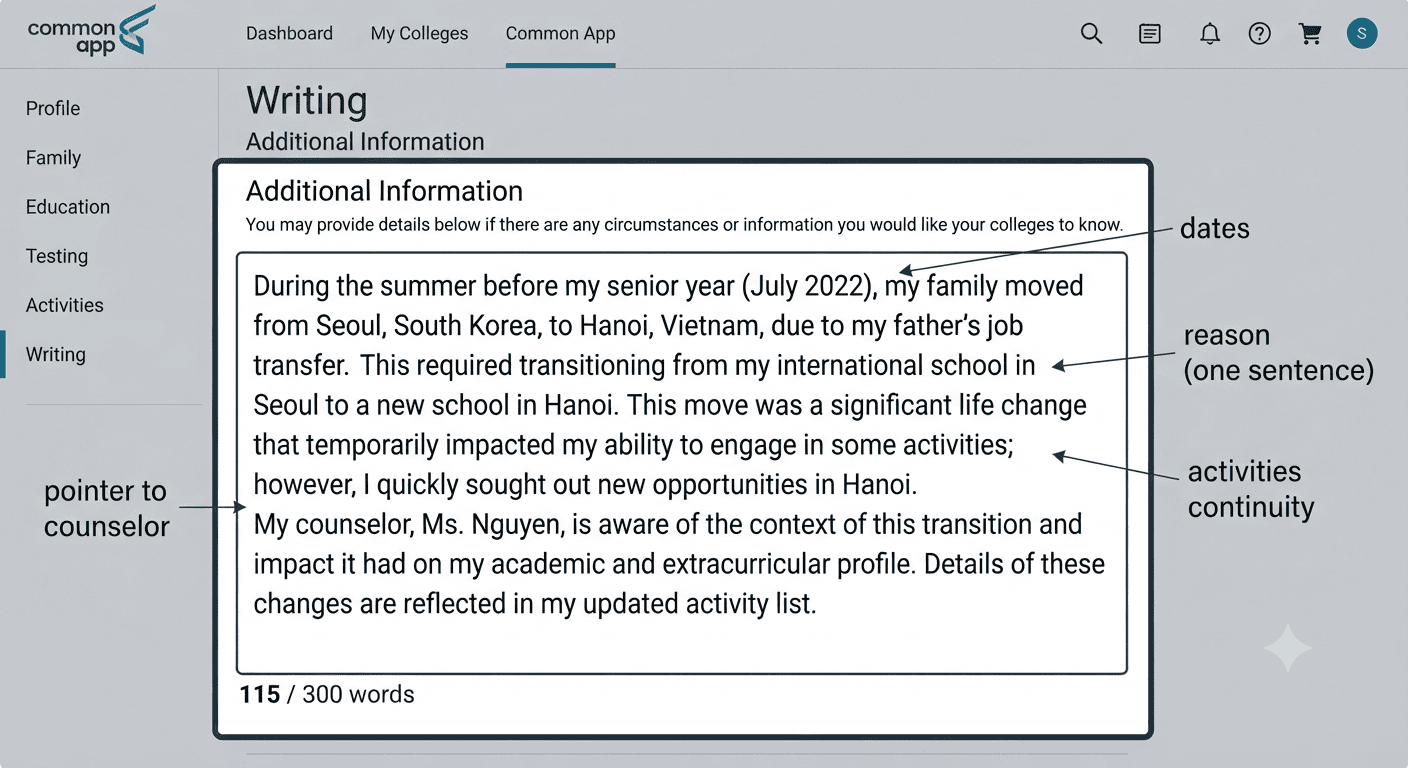
The counselor should explain it, not the student. Naesin is relative grading: a grade reflects a student's rank within the course cohort rather than a fixed standard. Band scales have changed in recent Korean reforms, so the school profile or counselor letter should say which scale applies. The student needs just one sentence: "My Seoul transcript uses Korean relative grading; my counselor's letter explains the scale."
No. Report grades exactly as each school issued them. Homemade conversions can introduce errors, and colleges generally prefer to see grades in their original form.
For non-English transcripts, usually yes, though requirements vary by college. Check each college's international admissions page and order certified translations early. They can take weeks.
Often, yes. An international move leaves behind several transcripts, and many colleges, including Tufts, ask for a separate one from each high school attended, including schools abroad. Check each college's requirements.
Start now, and follow up in writing. Ask the current counselor to note the delay in the Secondary School Report, and keep unofficial copies on hand. Some colleges accept an unofficial copy with the application and the official one later.

The counselor handles the school layer; the student handles the timeline. The counselor letter is part of the Secondary School Report, and it's usually the most credible third-party explanation of a move. Readers give it weight because it comes from the school, not the applicant.
| Task | Counselor | Student |
|---|---|---|
| Explain grading scales | Yes | One-line pointer only |
| Explain a curriculum change (e.g. Korean → AP) | Yes | — |
| Confirm dates of enrollment | Yes | Yes |
| Explain the reason for the move | Optional | One sentence |
| Describe adaptation and growth | Optional | Personal essay, if chosen |
Often, yes. If the counselor letter and school profile already cover the move, the student can leave the section blank. Confirm that in a meeting rather than assuming it.
Then the current counselor fills the gap by briefly describing the old school in their letter. If that isn't possible, the student's 300 words need to carry more: school type, grading scale and language of instruction.
Yes. For 2026–27, counselors can add a text update to the midyear report, either instead of or alongside a document upload. That helps students who moved late in Grade 11 or early in Grade 12.
This section reflects counselor practice, not a Common App rule. Principal Gerald Schoen has led schools in the US, Mexico, Korea, China and Thailand for more than 23 years, and students moving between those systems run into the same transcript problems every year.
Use dates. A calendar mismatch is what causes most repeated or skipped grades, and it should be stated plainly in Education History or Additional Information.
Admissions office statement
USC's admission team advises students who have made a significant move, or moved often, to "lay out a timeline for us to help connect some dots."
Source: USC Admission Blog, "Utilizing the Additional Information Section"
| Problem | Cause | What to write |
|---|---|---|
| First-semester dip | Switch to English-medium instruction | Dates + one sentence on the language change |
| Repeated semester | Korean year starts in March; Vietnamese and US years start in August–September | Exact months at each school |
| Skipped grade | Indian year starts in April | Grade levels and dates at each school |
| Three or four transcripts | Multiple moves (e.g. Mumbai → Singapore → Hanoi) | Bullet timeline, one line per school |
A dip with context raises far fewer questions than a dip without one, and a clear timeline provides that context. A timeline explains a transition, though, not a trend. If grades keep falling well after the first semester, readers may see a decline rather than an adjustment period.
Planning tests around a relocation as well? Our guide to SAT and AP testing plans when you relocate mid-year covers that side.
List the old activities honestly, with dates. If the gap is large, add one sentence in Additional Information.
The 2026–27 Common App helps here. The Activities section is now called "Activities and experiences," and the position/leadership field is optional, so lost leadership roles may look less like gaps than they used to. A former cricket captain should still list cricket. Include the years, note that the new school has no team, and then show what he started instead.
Use these as models for structure, not wording. Swap in your own details where you see brackets.
School history: I attended [School A], a public general high school in Seoul, from March 2024 to July 2025 (Korean Grade 10 and one semester of Grade 11). My family relocated to Hanoi for my father's work.
Calendar: Because the Korean school year begins in March, I entered Grade 11 at [current school], an American-curriculum school, in August 2025. I repeated one semester of Grade 11 content, now taught in English.
Grading: My Seoul transcript uses Korean relative grading (naesin). My counselor's letter explains the scale.
Activities: I led my Seoul school's science club in Grade 10. I joined the robotics team in Hanoi in Grade 11.
School history: I studied at [School B], a CBSE school in Bengaluru, through Grade 9 (April 2023–March 2024). I joined [current school] in Hanoi in August 2024 for Grade 10.
Grading: My CBSE marks are percentages. My current school uses letter grades and offers AP courses.
Transition: My first-semester English grade was a B+. It rose to an A– by second semester as I adjusted to US-style writing assignments.
Feelings, apologies, parents' job titles and lessons learned. If those belong anywhere, it's the essay.
Only if the student has a specific insight no other applicant could write. Generic "moving taught me resilience" essays blur together; specific ones stand out.
| Generic version | Specific version |
|---|---|
| "Moving to Vietnam taught me to adapt." | "I learned to bargain for xôi in Vietnamese before I could write a five-paragraph essay in English." |
| "I made new friends." | "My Korean and Vietnamese classmates built a shared slang. I kept a notebook of it." |
If the move becomes the essay, leave it out of Additional Information. The two sections shouldn't overlap.
Many students should leave the Additional Information section blank. If the school profile, counselor letter and transcripts already make the move obvious, a fourth explanation adds little. It just takes up the reader's time. "Always explain the move" isn't universal advice. Neither is ours.
Single case
One third-culture student describes a transcript with four schools across three countries, none sharing the same grading system. It is a single account, not typical of every family, but it shows when the student's own explanation becomes necessary.
Parents supply the facts; the student writes the sentences. Provide dates, school names, transcripts and documents, and let your child do the writing. Admissions readers can often tell when a parent wrote the draft. It dwells on the parent's job and says little about how the student adjusted.
Run this five-point test. Every "no" needs fixing.
| Check | What a "yes" looks like |
|---|---|
| Every sentence contains a fact or date | You can point to a document for each line |
| No apology words | No "unfortunately," "sadly" or "I'm sorry" |
| Under 300 words | Ideally 90–150 for a straightforward move |
| Points to the counselor letter for grading | One pointer sentence, once the counselor has confirmed |
| No college named | The text works for every college on the list |
Nothing you paste is sent or saved. Flags are prompts to review, not automatic errors, and the Common App's own word counter may differ slightly from this one.
Then ask the school counselor or an English teacher to read it once.
In our experience, usually not, for this section alone. A 300-word factual timeline rarely needs expensive help. What it does need is a good working relationship with the school counselor. Private help, such as an independent educational consultant (IEC), makes sense in a few specific cases.
| Situation | Worth considering? |
|---|---|
| School counselor knows the student and writes detailed letters | Rarely |
| Counselor is new, overloaded or unfamiliar with the student | Yes |
| Three or more transcripts, some without profiles | Possibly |
| Help needed with the essay and full college list, not just this section | Possibly |
| Only the 300-word timeline needs work | Rarely |
Support across the whole application is a separate decision. It depends on your budget, your child's college list and how much the school's counselors can take on. Fees vary widely in Hanoi and Ho Chi Minh City. Before you pay, get the scope in writing: who writes, who edits and what's excluded. A reputable advisor won't offer to write the section for your child.
Many Regular Decision deadlines fall on or around January 1, but each college sets its own date. Work backward from the earliest one.
From transcripts to submit, November 2026 to January 2027
Five stages for families explaining a move
Collect
Late November
Transcripts, translations, school history sheet
Draft
Early December
Timeline under 300 words
Review and decide
Mid-December
Check dates; choose the right box, or blank
Confirm
Late December
Documents received; preview PDF checked
Submit
By January 1, 2027
Save copies of everything
Note: January 1 is a common Regular Decision date, not a universal one. Use your child's earliest real deadline.
Tick each item as you complete it. Your progress is saved in this browser, so you can come back to it.
0 of 12 done
Your ticks are saved in this browser only; nothing is sent to True North.
True North International School is an American-curriculum K–12 school in Hà Đông, Hanoi. Graduates receive a US high school diploma. The school holds ACS WASC accreditation for all grade levels, granted in May 2024, and teaches College Board's Advanced Placement program. In the International Track, AP courses are included in tuition. Fees are published on the admissions page.
The parent community is truly international, with Vietnamese, Korean, Indian and German families, and many students join partway through secondary school with transcripts from other systems. The school's first graduating class received offers from more than 30 international universities, including Cornell, UCL, the University of Melbourne and the University of Sydney, and earned scholarships totaling US$3,000,000 in the US and AU$80,000 in Australia. International Track students scored 1550 (2023) and 1570 (2024) out of 1600 on the SAT.
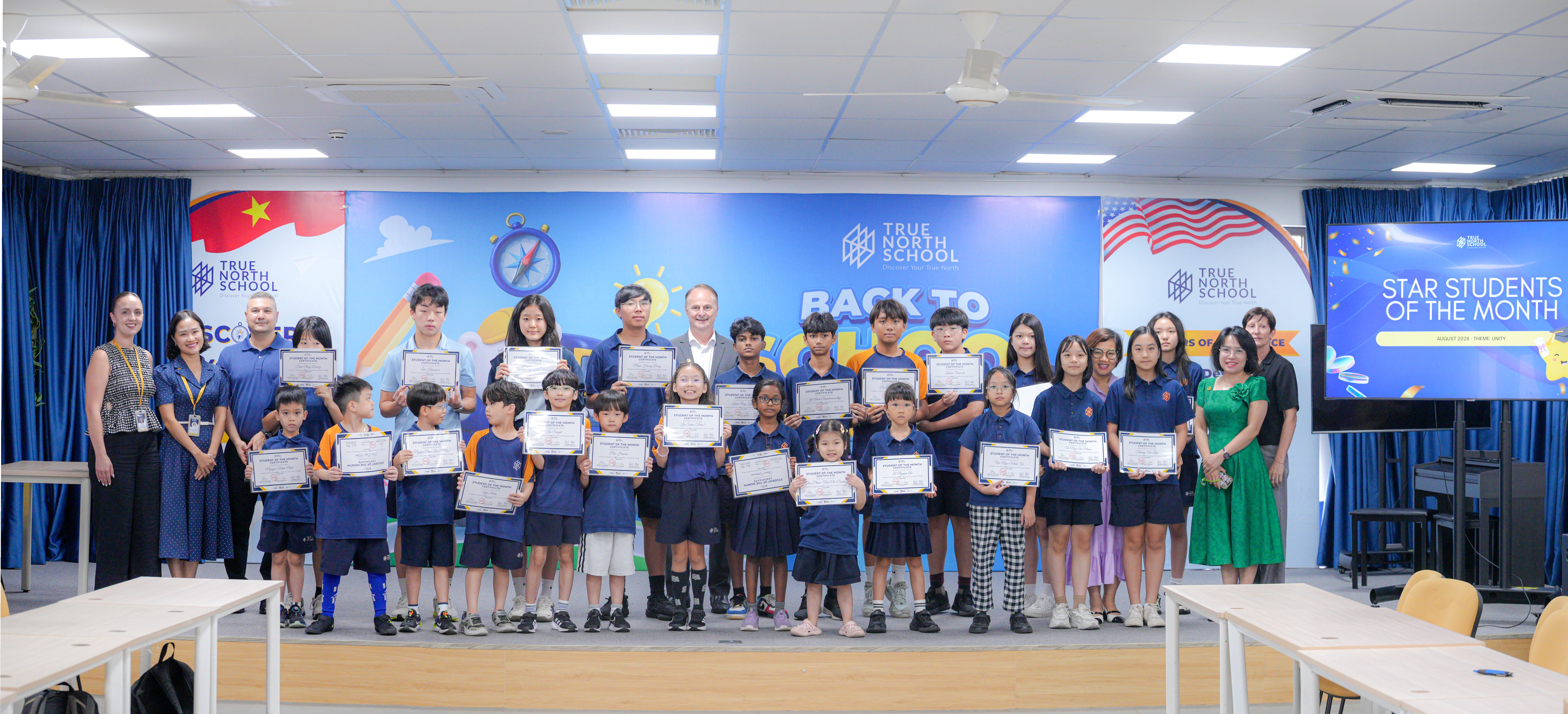
Before enrolling, ask the admissions team how transfer students' previous transcripts are reviewed and who writes the counselor letter. The example below shows what a sound intake looks like, so you know what to expect from the answer.
Families arriving from abroad may also find our guide on moving to Hanoi with teenagers useful.
Request every previous transcript. Book a meeting with the counselor. Start the school history sheet. These three actions cover the parts of the process a family controls, and everything else in this guide builds on them.
An international move is context, not a weakness. Leave the school layer to the counselor, keep the student layer to a factual timeline, and use the story layer only if it's the student's best story. For the family moving from Seoul to Hanoi in Grade 11, that means Additional Information rather than Challenges and Circumstances, a counselor who explains naesin, and holding off on a private counselor unless the school's support is thin.
This guide reflects Common App's 2026–27 application and counselor practice as of November 2026; we'll review it when the 2027–28 changes are announced. Families who want to check a specific case can contact True North International School.
Contact us now: 02473043768 and 0388387899 for a free consultation!
Author: Kiều Trọng Tú, compiled from Common App update documents and admissions office guidance; updated November 2026. Reviewed by: Nguyễn Bảo Trung.
| Source | What it supports in this article | Evidence type |
|---|---|---|
| Common App – What's New 2025–26 | Additional Information cut from 650 to 300 words; mean below 300 and median below 200 over five cycles; Challenges and Circumstances at 250 words | Published policy |
| Common App – What's New, First-Year 2026–2027 | 210+ countries and territories; about 10% international; "caregiving" wording; Activities and experiences; midyear report text update | Published policy |
| IIE Open Doors 2025 – Fast Facts | India 363,019; China 265,919; South Korea 42,293; Vietnam 25,584 (+15.9%) | Published data |
| Dartmouth Admissions – Different curriculum or grading system | Applications reviewed within the context of each school's curriculum and grading system | Admissions office |
| USC Admission Blog – Utilizing the Additional Information Section | Lay out a timeline after a significant move | Admissions office |
| USC Admission Blog – 2025/2026 update | Two-part section; sent to every college; not confidential | Admissions office |
| Tufts Admissions – Common unique questions | Separate transcripts from each school; explaining school changes | Admissions office |
| Inside Higher Ed – Common App responsibilities data | International and first-generation students more likely to report extenuating responsibilities; not proof of harm | Correlational data |
| College Transitions – Should I use the Additional Information section? | 300-word section alongside the optional Challenges and Circumstances essay | Press and secondary |
| CollegeVine Q&A – Moving countries mid-year | Explaining the circumstances of an international move in Additional Information | Press and secondary |
| Uni2Study – School profile and counselor letter problem | Gaps when schools abroad have no profile or counselor | Press and secondary |
| Third Culture Compass – Common App guide | One student's four schools in three countries (single case) | Single case |
See all

ES Tet Unites, Vietname Delights
2025
Bilingual

ES Ringing in the New Year Showcase
2025
International

MSHS Bil Semester 1 Reflection & Award
2025
Bilingual
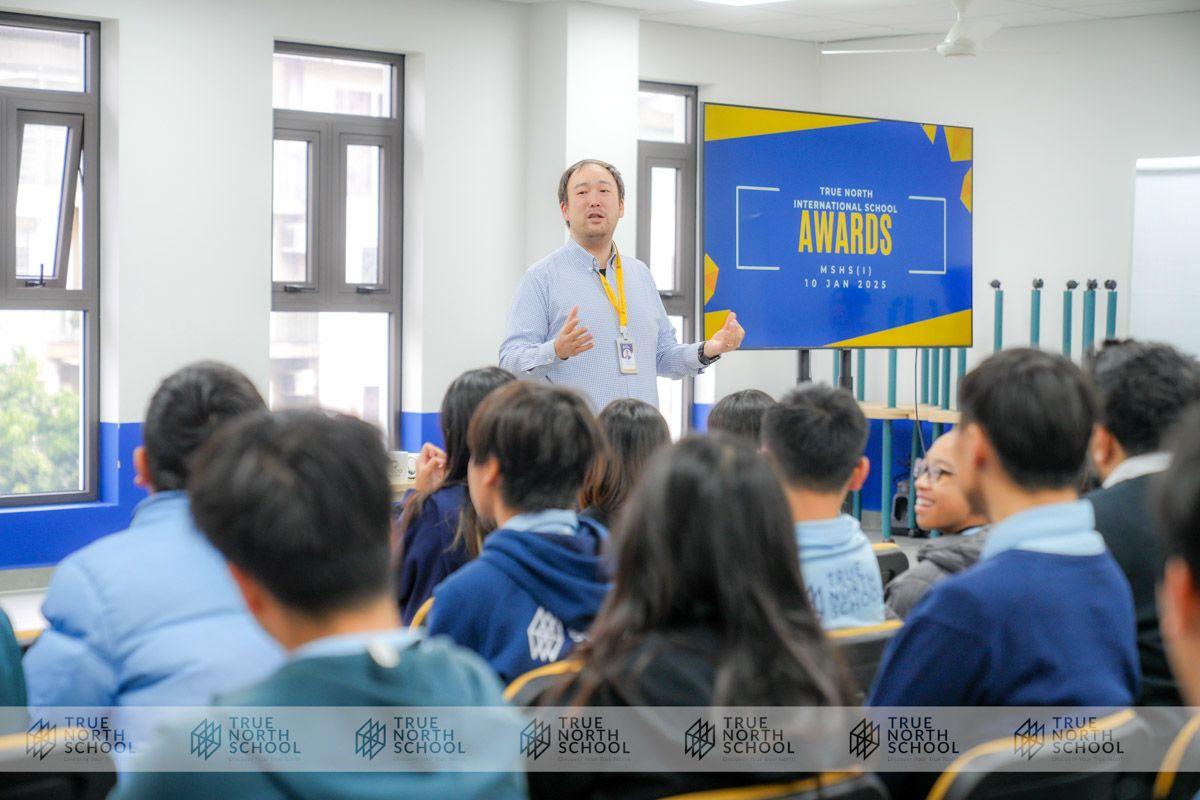
MSHS Student Awards Ceremony in Semester 1
2025
International

ES First Semester Highlights and Awards
2025
Bilingual

Winter Around the World 2024
2024
All tracks

November
18
Superscore and Score Choice Explained: Sending SAT Scores Strategically
Superscore and Score Choice explained for parents in Vietnam, India, China and Korea: which SAT sittings to send to Penn, Georgetown and CMU, when to skip the free reports, and whether a December retake is worth it before January deadlines.

November
17
SSD Accommodations for SAT and AP: What Families Need to Know When Changing Schools
SSD Accommodations for SAT and AP stay with your child when changing schools, but the new school must record the transfer in SSD Online. Find your SSD number, the January 22, 2027 AP deadline, and a three-week checklist

November
16
Moving to Hanoi With Teenagers: Choosing Between American, IB and Cambridge Schools
Moving to Hanoi with teenagers? Compare American, IB and Cambridge schools by university destination, 2026-27 fees, waitlists, Grade 11 entry and commute, with a clear recommendation for Indian, Korean, Chinese and Vietnamese families on a $30,000 budget who may relocate again.