International School in Hanoi: Guide for Indian Parents
Posted On: 19 September, 2026
Relocating to Hanoi from India? A clear-eyed guide to choosing the right international school — curriculum equivalence, real costs, admissions timing, and community, explained.
The Indian Parent's Guide to Choosing an International School in Hanoi
An international school, in the Vietnamese context, is a private K-12 institution licensed by the Ministry of Education and Training to teach a foreign or globally recognized curriculum — IB, British, American, or a bilingual hybrid — rather than the standard Vietnamese national program. For an Indian family arriving on a work visa or the new Golden Visa, the term hides a more specific problem: none of these curricula map cleanly onto the CBSE or ICSE system your child just left, and the admissions calendar for most of them runs on a different clock than the one back home.
Choosing well means solving three things at once — which curriculum protects your child's options if you return to India, whether the school's intake dates fit your actual move date, and what the fee sheet looks like once every line item is added up, not just the headline tuition. Before you shortlist a single school, have three facts ready: your child's current grade, their present board (CBSE, ICSE, or state), and the month you expect to land in Hanoi. Everything else follows from those three.
Curriculum Continuity Beats Campus Prestige
A swimming pool and a robotics lab photograph well. They don't answer the question that actually keeps an Indian parent up at night: if this posting ends in three years and the family returns to India, does the curriculum survive the trip back? Curriculum choice, not campus glamour, decides whether a child re-enters the Indian system without losing a year. And CBSE-equivalency anxiety is really just one piece of a bigger concern — the return-to-India risk that shadows the whole decision.
Hanoi's international schools cluster around four curriculum families. The table below maps them against the question that matters most to a relocating Indian family: what happens on re-entry.
Curriculum
Examples in Hanoi
Exit Qualification
Re-entry to India
IB continuum (PYP–MYP–DP)
UNIS Hanoi, Hanoi Academy
IB Diploma
Recognized by AIU; university entry straightforward, school-level transfer needs case-by-case evaluation
British (IGCSE/A-Level)
BIS Hanoi
IGCSE + A-Level
Widely accepted; A-Level equivalence to Class 12 assessed individually by Indian universities
American (AP)
Concordia International School
High School Diploma + AP credits
Accepted for university admission; K-12 transfer requires an equivalency certificate
Bilingual / MOET Track
True North International School (Hà Đông)
Vietnamese MOET certificate + international exposure
Suits families uncertain of their India return date; keeps a Vietnamese-recognized credential as a fallback
The CBSE-to-IB Question: What Actually Transfers
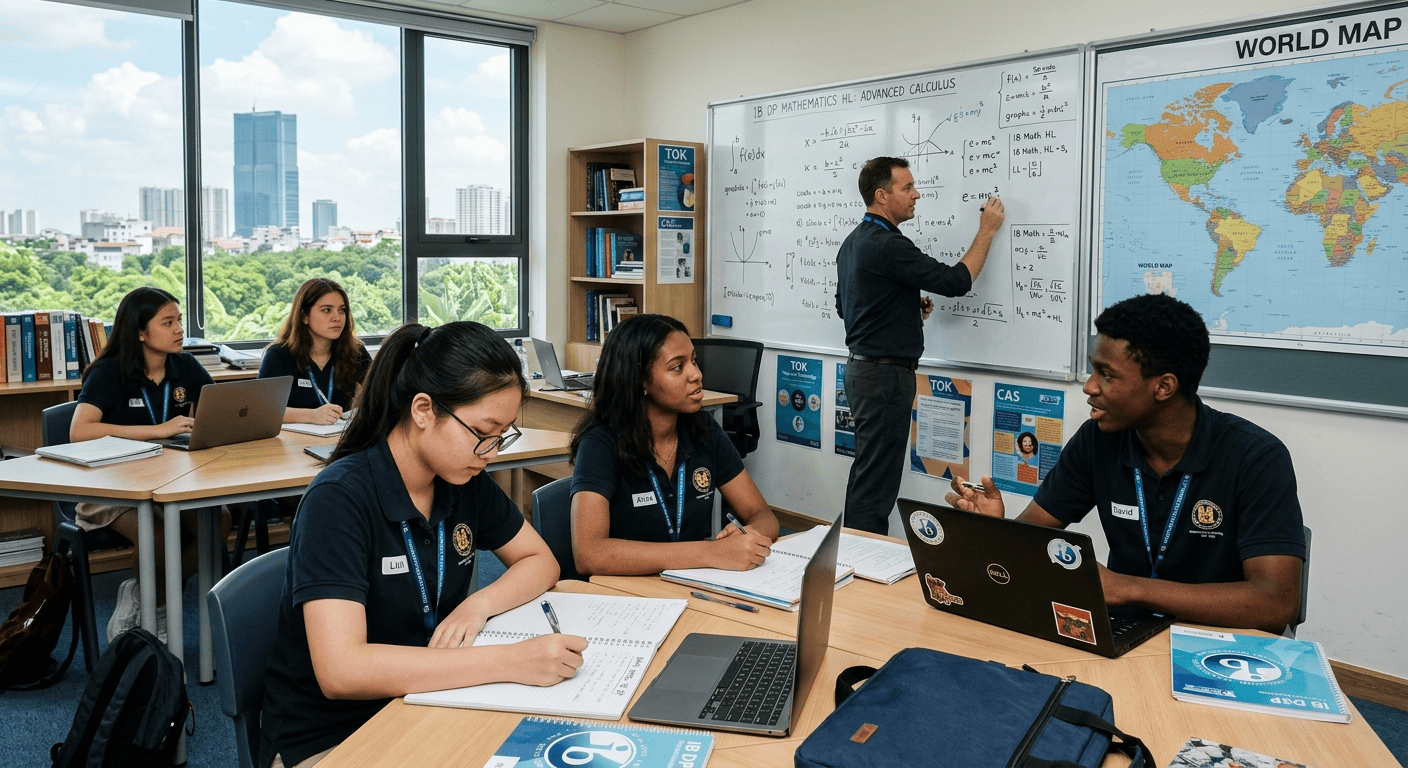
No Hanoi school issues a direct CBSE-to-IB conversion certificate — that document simply doesn't exist. What transfers is subject-level readiness, not the board itself. Educators familiar with both systems generally say CBSE's Class 10–11 syllabus overlaps substantially with IB Diploma Higher Level prerequisites in Math and Physics. The same isn't automatically true of the IB's Theory of Knowledge or Extended Essay components, which have no CBSE analogue and demand a different kind of academic writing entirely.
For families anxious about diluted math-and-science rigor, the more useful comparator is a school's own outcome data, not the curriculum label alone. True North's own reported figures show an average AP score of 4.4 out of 5 across the 2023–24 academic year, with 98% of sittings scoring 3 or above. That's one school's self-reported result, but it's a concrete benchmark against which to test the fear that "international" curriculum means softer academic standards.
PRO TIP TRUE NORTH INTERNATIONAL SCHOOL: If your child is entering Grade 11 or 12, check the AP exam registration window before you finalize your move date, not after. College Board typically closes registration for the May exam sitting in early-to-mid November of the preceding year. A family that lands in Hanoi in December has effectively missed that year's AP cycle and will need to wait a full academic year before their child can sit for AP exams — a detail that rarely comes up in relocation planning meetings but directly affects a Class 11 student's university application timeline back in India.
Where a family plans to return to India specifically for NIOS or a state-board re-entry rather than a fresh CBSE enrollment, an equivalency certificate from the Association of Indian Universities becomes the document that actually matters — not the school's own transcript. Requesting this early, before departure from Vietnam, saves a scramble during the return move.
The Calendar Trap: India's April Year vs. Vietnam's August Year
The April-to-September calendar mismatch drives most of the mid-year-enrollment anxiety Indian families report. India's academic year runs April to March; Hanoi's international schools set their primary intake for August or September, following the Northern Hemisphere calendar. A family relocating in June — a common month for corporate transfers — lands squarely between two academic years, neither of which has just started.
PRO TIP TRUE NORTH INTERNATIONAL SCHOOL: Start the Transfer Certificate (TC) process at your child's current Indian school the same week you accept your offer letter — not the week before you fly. Most Indian state education boards require a TC to be countersigned and stamped by the District Education Officer (DEO) before it's valid for enrollment abroad. That stamping step commonly takes two to four weeks — longer during exam season, when DEO offices are backlogged. Families who leave this until the final month often arrive in Hanoi able to start classes but unable to complete formal enrollment paperwork until the TC catches up by post.
What actually solves this is rolling admissions, which most Hanoi international schools run instead of a single annual entry window. True North's process shows the sequence a mid-year arrival can expect:
Step
What Happens
Typical Duration
1 Enquiry Form
Online registration submitted
Response within 3 business days
2 Competency Assessment
Campus tour, entrance exam, family interview
1 visit
3 Application
Enrollment form submitted via email or reception
—
4 Offer Letter
Test results and offer issued
—
5 Acceptance
Signed offer + registration fee/deposit returned
Within 7 working days of results
True North's entrance test is free, and free testing is common practice at Hanoi's international schools generally — fee policies do vary school to school, so confirm before assuming. That means a family can test a child's fit before committing financially, which matters when the alternative is guessing from India. Begin the enquiry three to four months out: the assessment-to-offer cycle, plus visa paperwork, eats up more calendar time than the admissions process alone suggests.
Money in Two Currencies: What a Hanoi Education Actually Costs
A school-fee allowance is one line item in a corporate relocation package, not a guarantee it covers the real cost. Several Hanoi and Ho Chi Minh City schools raised tuition 3–5% for the 2025–26 year, and premium-tier annual fees now approach $38,500 at the top end of the market — a ceiling worth knowing before you negotiate an allowance figure with HR back in India.
Market trackers report the median true annual cost across Hanoi's international schools — tuition plus hidden fees — sits near $19,500, with hidden fees adding roughly 9% on top of published tuition. That figure comes from one tracker's own methodology, not an independent audit — useful as a directional benchmark, not an exact number for any single school.
— Source: WhereNext, International Schools in Hanoi: Cost, Quality & Market Intelligence (2026 data)
Trackers like WhereNext started publishing "true cost including hidden fees" benchmarks for a simple reason: published tuition tends to understate what a family actually pays once registration, buses, and materials are added in.
— Source: WhereNext school-cost database, 2026
🧮 Calculate Your True Cost
True Cost of Schooling Calculator
Enter the tuition figure your school quoted — see what you'll actually pay once the standard extra fees are added.
Estimated True Annual Cost
Approximate conversion only (rates fluctuate). Excludes uniform, meal plan, and AP exam fees — confirm exact grade-level figures with admissions.
PRO TIP TRUE NORTH INTERNATIONAL SCHOOL: Before wiring the Initial Payment, ask the admissions office in writing what happens to that sum if your visa or Golden Visa application is delayed or denied after you've paid but before your child has started classes. Policies differ school to school, and some treat the Initial Payment as fully forfeited once paid, regardless of whether the child ever attends. Given that this figure runs 50–70 million VND (roughly $2,000–2,900), get the refund policy in writing — not verbally from a sales-facing admissions counselor.
Tuition Fees
True North's Foundation Year tuition runs 300,000,000 VND (~$12,245) annually, payable in full or across two terms of 157,500,000 VND (~$6,430) each. International Track and MOET Track figures vary by grade level and are confirmed directly by the admissions office at truenorth.edu.vn/en/admissions — check this before finalizing an employer's fee-allowance figure, since grade-level variance can be significant even within a single school.
Other Fees
Fee
PreSchool
International Track
Bilingual Track
Development fee
25,000,000 VND (~$1,020)
25,000,000 VND (~$1,020)
25,000,000 VND (~$1,020)
Learning material fee
10,000,000 VND (~$408)
30,000,000 VND (~$1,225)
20,000,000 VND (~$815)
Uniform fee
2,500,000 VND (~$102)
2,500,000 VND (~$1,02)
2,500,000 VND (~$1,02)
Insurance fee
1,500,000 VND (~$61)
1,500,000 VND (~$61)
1,500,000 VND (~$61)
Meal fee
30,000,000 VND (~$1,225, breakfast incl.)
25,000,000 VND (~$1,020, excl. breakfast)
25,000,000 VND (~$1,020, excl. breakfast)
AP fee
—
Included in tuition
18,000,000 VND (~$735) per AP subject
Bus fees add a further tier by distance and schedule, from roughly 17,500,000 VND (~$715) one-way within 5km to 39,000,000 VND (~$1,590) round-trip beyond 15km. Map this against your neighborhood shortlist before signing a lease — it changes the math more than most families expect.
CURRENCY AND CASH-FLOW MISTAKES:
Assuming annual allowance covers termly billing: Many employer relocation packages disburse school allowances annually or even at year-end reimbursement, while Hanoi schools typically bill termly or require a lump-sum Initial Payment upfront. This mismatch has left more than one family covering the first term out of pocket while waiting on employer reimbursement — confirm your employer's disbursement schedule against the school's payment schedule before signing.
Ignoring wire-transfer fees and exchange-rate spread: International wire transfers between India and Vietnam typically lose an estimated 1–3% to exchange-rate spread and fixed fees. On a $15,000–20,000 annual tuition figure, that's easily $150–600 a year in avoidable cost. Confirm exact costs with your bank or transfer provider, and compare a fee-transparent transfer service against a standard wire before the first payment.
The 2026 dissolution of American International School Saigon (AISVN), following a financial controversy, is one well-documented case rather than a sector-wide pattern in Vietnam — but it's exactly the kind of case that justifies asking a shortlisted school directly about its ownership structure and financial backing before you pay an initial deposit of several thousand dollars. True North's fee schedule is published in full on its admissions page, and the school's 2025 strategic investment from Gaw Capital (part of the NPX Point Avenue Group) alongside its 2021 Sun Group campus partnership are matters of public record, reported in the Vietnam Investment Review and The Asset.
Vegetarian, Jain, and the Question of Food
Vegetarian and Jain food provision meets a religious-dietary need specific to Hindu and Jain families, and it rarely shows up in a school's admissions brochure — parents generally have to ask. The honest answer for most Hanoi international schools: a vegetarian option exists on the cafeteria menu, but a fully Jain-compliant kitchen (no onion, no garlic, no root vegetables) is uncommon, and usually needs a direct arrangement with the school's catering team rather than an off-the-shelf menu choice. Hanoi's own food scene fills the gap outside school hours — the city has pure-vegetarian Indian restaurants that come up repeatedly in expat and traveler recommendations, specifically for Jain-friendly preparation.
How Many Indian Families Will Actually Be There?
Vietnam's total Indian population stood at roughly 2,700 people as of 2025, concentrated mainly in Ho Chi Minh City rather than Hanoi.
— Source: Indians in Vietnam, Wikipedia (2025 population data)
Here the marketing claim and the demographic reality diverge, and it's worth saying so plainly. Indian diaspora population size directly shapes how much peer community actually exists at any given school. That makes it mathematically unlikely any single Hanoi school hosts more than a handful of Indian families. One caveat: word-of-mouth within a small diaspora can cluster families at one or two schools rather than spread them evenly across the city — worth asking about directly rather than assuming either way.
UNIS Hanoi enrolled over 1,100 students representing 66 nationalities, based on the most recently published figures.
— Source: United Nations International School of Hanoi, Wikipedia
This changes the calculus between flagship and mid-tier schools. UNIS Hanoi and BIS Hanoi are widely regarded within Hanoi's expat community as delivering strong IB and university-placement outcomes at the premium end of the fee scale. Worth flagging, though: that reputation can partly reflect who ends up there in the first place — families with more resources and academically stronger students tend to gravitate to flagship schools — rather than proving the curriculum itself is superior. For a family expecting to relocate again within two to three years, a common posting length for IT/GCC and banking transfers, a mid-tier or bilingual school can mean a lighter enrollment-fee commitment and a cleaner exit if the assignment ends early. Ask each shortlisted school directly for its current Indian or South Asian enrollment count rather than reading it off the marketing photography. A school's willingness to answer that question plainly is itself a useful signal.
TRUSTING OUTDATED COMMUNITY CLAIMS:
Relying on old Facebook or expat-forum threads: Posts about a school's "Indian community" or academic reputation from three or four years ago may no longer hold — ownership changes (as with the 2025 Gaw Capital investment structures now common across Hanoi schools), accreditation renewals, and even principal turnover can shift a school's profile within a single admissions cycle. Treat forum posts older than 12–18 months as a starting point for questions, not as current fact.
Not asking for a number, only a vibe: "We have a diverse international community" is not an answer. Ask admissions directly: how many Indian or South Asian families are currently enrolled, in which grade levels, and would they be willing to connect you with one for an informal conversation. A school confident in its numbers will usually say yes to that last part.
On language and extracurriculars: Vietnamese-language instruction is typically an elective for international-track students, not a requirement. Clubs covering debate, robotics, and performing arts are common — cricket or Indian classical dance, though, usually depend on parent-organized groups within the broader expat community rather than the school's own club roster.
Visa Rules and School Enrollment
Dependent-visa status governs a child's legal eligibility to enroll in a Vietnamese school, and enrollment paperwork typically requires proof of that status before a seat is confirmed — not merely applied for.
According to industry relocation commentary — rather than a codified education-ministry rule — Vietnam's 10-year Golden Visa, introduced in 2025–2026 and explicitly marketed toward Indian investors and professionals, grants family residency that functions as a practical precondition for school enrollment under this pathway.
— Source: Travel And Tour World, Vietnam Launches New 10-Year Golden Visa Program to Attract Indian Investors and Professionals (2025)
Families relocating on a standard work-dependent visa should confirm the same underlying requirement — secured residency status — applies before submitting a school application.
Where to Live: Neighborhoods and Safety
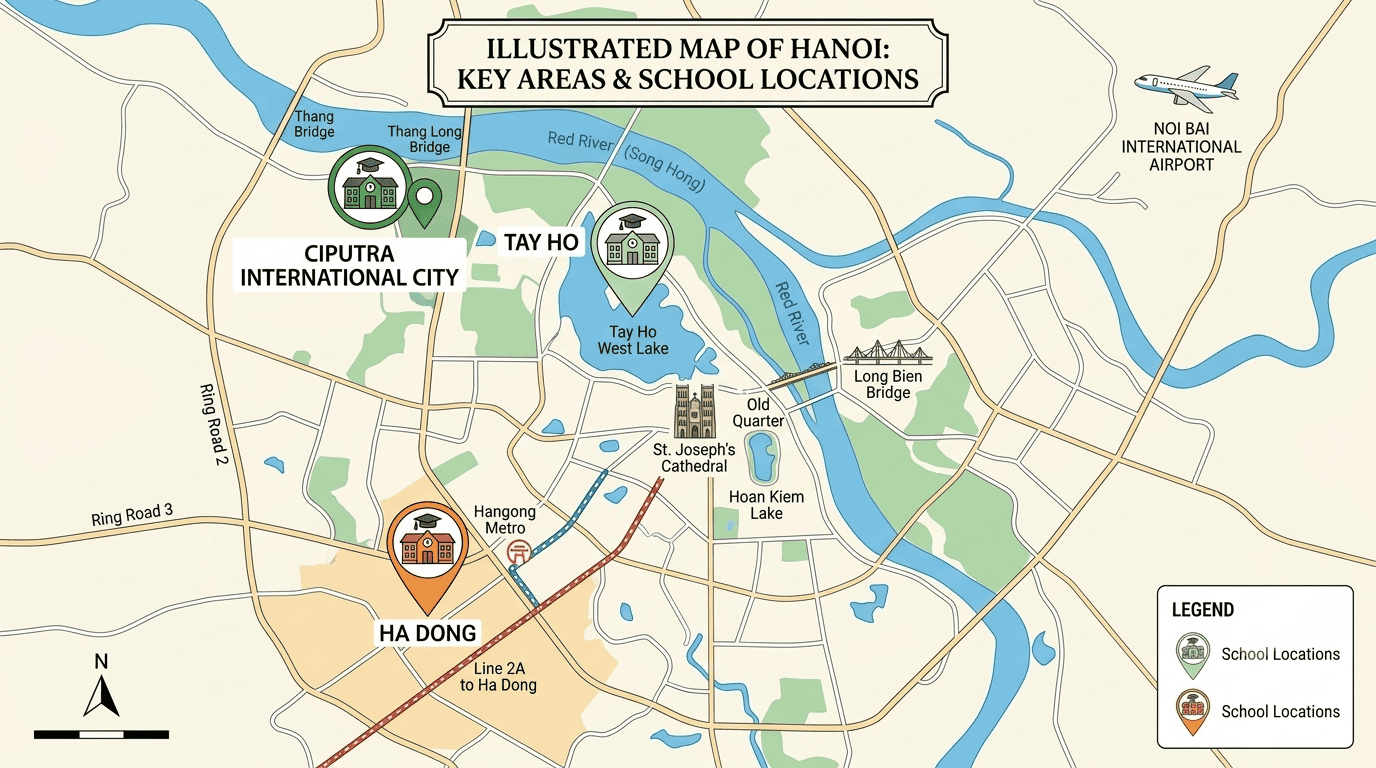
Hanoi's international-school families concentrate in a small number of districts, and school choice and neighborhood choice tend to get decided together rather than one after the other. The Tay Ho (West Lake) expat enclave hosts UNIS and BIS and remains the most established base for diplomatic and corporate expat families. Ciputra, a planned residential development in the north of the city, sits close to several mid-tier schools and appeals to families who'd rather cut commute time than stay near the diplomatic quarter. True North's own campus sits in Hà Đông, on the western edge of the city — a longer commute from Tay Ho, but a common choice for families whose employer's office is on that side of Hanoi. Relocation guides and expat communities commonly describe Hanoi as a low-crime city for families with children, though no article-level crime statistics are cited here — verify current safety data for your specific district before deciding. The safety concern that comes up more consistently in practice is traffic, not crime — a factor the bus-fee distance tiers above indirectly capture.
A Practical Timeline for Families Relocating from India
Timeline Before Move
3–4 months out
Submit enquiry forms to 2–3 shortlisted schools; request current fee schedules and Indian/South Asian enrollment figures
2–3 months out
Complete entrance assessments (in person or remotely where offered); confirm curriculum-equivalence plan with current CBSE/ICSE school
6–8 weeks out
Receive Offer Letter; sign and return within the school's acceptance window (7 working days at True North)
4–6 weeks out
Finalize dependent-visa or Golden Visa paperwork tied to enrollment proof
2 weeks out
Confirm bus route/distance tier, uniform sizing, and meal-plan dietary requests (vegetarian/Jain)
Arrival week
Attend school orientation; complete final registration paperwork on campus
For families ready to move from research to action, True North's Admissions Department responds to enquiry forms within three business days and can walk through curriculum fit, fee schedules by grade, and the current Offer Letter timeline directly: truenorth.edu.vn/en/admissions.
Frequently Asked Questions: International Schools in Hanoi for Indian Families
Will my child's CBSE marks be accepted for admission into an IB or British-curriculum school in Hanoi, Vietnam?
Yes, in most cases. Hanoi's international schools admit based on an entrance assessment and interview, not board-specific transcripts, so CBSE report cards are accepted as supporting documents rather than a barrier. CBSE's Math and Science content generally aligns well with IB Diploma Higher Level prerequisites. What does not transfer automatically are IB-specific components like Theory of Knowledge or the Extended Essay, which have no CBSE equivalent — expect the school to place your child based on the entrance test, not the previous board alone.
My family's move date falls between school terms — can we still enroll mid-year in Hanoi?
Yes. Most Hanoi international schools, including True North, operate rolling admissions rather than a single annual intake, specifically because families relocating from India's April-start academic year rarely arrive in August or September. The process is: submit an enquiry form, complete a free entrance assessment, receive an Offer Letter, then confirm within about 7 working days. Start the enquiry 3–4 months before your move date to allow time for the assessment cycle and visa paperwork to run in parallel.
What do I do if my child's Transfer Certificate (TC) isn't ready by the time we relocate to Vietnam?
Most Indian state boards require the TC to be countersigned by the District Education Officer (DEO) before it's valid abroad, and that step can take 2–4 weeks. If your TC is delayed, most Hanoi schools will let your child begin attending classes provisionally while the stamped TC follows by post — confirm this specific accommodation with the admissions office in writing before you fly, since policies on provisional attendance without a TC vary by school.
Is vegetarian or Jain food actually available at international schools in Hanoi, or do I need to pack lunch daily?
A vegetarian cafeteria option exists at most Hanoi international schools, but a fully Jain-compliant kitchen (no onion, garlic, or root vegetables) is uncommon as a standing menu item — it usually requires a direct, individual arrangement with the school's catering team. Ask this question to the admissions office before enrollment, not after. Outside school hours, Hanoi has several dedicated pure-vegetarian and Jain-friendly Indian restaurants that expat families rely on regularly.
How do I get my child's foreign schooling recognized if we return to India partway through the school year?
Request an equivalency certificate from the Association of Indian Universities (AIU) before leaving Vietnam — this is the document Indian schools and universities actually check, not the Hanoi school's own transcript. Start this process while still enrolled in Vietnam, since it's significantly harder to obtain after the child has already left the school. Families returning to a state-board or NIOS pathway specifically should confirm AIU equivalency requirements with their target Indian school in advance.
Our employer's school allowance was quoted in USD but the school bills in VND — how much am I actually losing to currency conversion?
International wire transfers from India to a Vietnamese school account typically lose 1–3% to exchange-rate spread and fixed transfer fees, on top of the quoted VND tuition figure. On a $15,000–20,000 annual tuition, that's roughly $150–600 per year in avoidable cost. Comparing a fee-transparent transfer service against your bank's standard wire before the first payment — not after several terms — is the practical fix.
How many Indian families are actually enrolled at a given Hanoi international school, and how do I verify a school's claim of a "diverse community"?
Don't rely on marketing photography or old forum posts — ask the admissions office directly for the current number of Indian or South Asian families enrolled, broken down by grade level, and request an introduction to one for an informal conversation. Given Vietnam's total Indian population was estimated at roughly 2,700 people nationwide as of 2025, no single Hanoi school likely hosts more than a small handful of Indian families regardless of size or prestige. For details on True North's own admissions process and fees, see the official admissions page.
Related Topics
How the Admissions Process Works at True North — Enquiry → Competency Assessment → Offer Letter → Acceptance, step by step.
One-Time Payment Fees Explained — Application, enrollment, and initial payment: what's due before your child's first day.
Tuition Fees by Track and Grade — Foundation Year, International Track, and MOET Track, paid annually or by term.
Other Fees: Meals, Uniforms, Transport, and AP — The recurring costs beyond tuition that families most often underestimate.
IB vs. British vs. American vs. MOET Curriculum — Comparing the four curriculum tracks available in Hanoi and which fits which family goal.
CBSE to IB: What Actually Transfers — Which subjects carry their difficulty level across, and which have to be relearned from scratch.
Getting an AIU Equivalency Certificate — The paperwork to start before leaving Vietnam if you plan to re-enter the Indian education system.
Transfer Certificate (TC) Timeline for Indian Students — Why the TC request should go in the week you accept the offer letter, not the week before you fly.
Vegetarian and Jain Meal Options in Hanoi Schools — How to ask the right question to find out whether a school can actually meet a vegetarian or Jain diet.
Vietnam's Golden Visa and School Enrollment — How the 10-year investor visa affects a dependent child's enrollment eligibility.
Best Neighborhoods for Indian Expat Families in Hanoi — Comparing Tay Ho, Ciputra, and Ha Dong on school proximity, cost, and community.
WASC Accreditation Explained — What this international accreditation actually signals about teaching quality.
Data Sources
Claim
Evidence Level
Source
Vietnam's ethnic Indian population was estimated at around 2,700 people as of 2025, concentrated mostly in Ho Chi Minh City
Vietnam's 10-year Golden Visa extends family-residency benefits including access to the education system; industry commentators expect this to draw more Indian professional and investor families
Indian diaspora educator Navneet Kalia introduced CBSE-style Math, Science, and English teaching methods into roughly 25 schools across Hanoi, Ho Chi Minh City, and Nha Trang